Is This Really That Terrible? For This Hand Now Over Poland Raised a Bullet In The Head
For this hand now over Poland raised A bullet in the head!"

German commandant of a transit-labor camp Adolf Wilhelms forced to hold a sign saying "I was the executioner of Poles at the Bayer's (factory) in 1939" before his execution, city of Łódź,April 1945. In April 1945, after the liberation of Łódź, the camp commandant Adolf Wilhelms was hanged.
Shortly before the execution took place, a photo of him holding a sign saying "I was the executioner of Poles at the Bayer's (factory) in 1939" was taken.
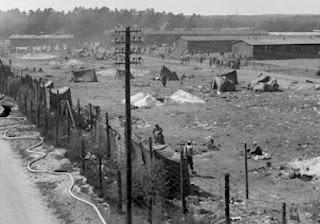
As the German Army started to lose the war, they were pushed into retreat towards Germany by the Allies. The Allies then began to liberate the hundreds of camps which the Nazis had constructed across occupied Europe.
On 23 July 1944, Majdanek, in eastern Poland, became the first extermination camp to be liberated by the Soviet Army. Abandoned quickly by the German forces, the camp was almost completely intact.
Over the following nine months, hundreds of camps were liberated across Germany and previously occupied territories, including extermination camps Auschwitz-Birkenau (by the Soviets in January 1945) and Bergen-Belsen (by the British in April 1945).
For many prisoners, liberation was only the beginning of their journey to freedom. The Nazis had stripped survivors of their jobs, their homes, and in many cases, murdered their families.
Most had nowhere to go, and many ended up being placed in Displaced Person camps until they could eventually emigrate or settle elsewhere.
The conditions in the camps also took a while to improve because of the poor conditions in post-war Europe. Disease was widespread, and the daily death rate initially remained high. In Bergen-Belsen, 10,000 people died from malnutrition and disease after liberation.
I appreciate you reading. Post your ideas in the space provided for comments below.
Read more on our Rare History Channel






Comments
Post a Comment